Scar Therapy
Massage therapy that works gently on scarring to improve mobility, appearance and functionalityScar Massage Therapy
Scar Massage Therapy works gently on the scar to improve mobilty within the tissues, the appearance of the scar and the functionality and healing process of the scar.
Scar massage is a way of softening and flattening scars. It can stop scar tissue building up and help make scars less noticeable. Your scar will continue to grow and change for about twelve to eighteen months, so the earlier and more regularly you massage your scar, the less the chance of long-term problems.
Scar massage can help:
-reduce itchiness or over-sensitivity of scars
-moisturise your scar if you use cream
-improve the flexibility, mobility and softness of scars
-make collagen form more evenly by applying pressure.
What happens during Scar Massage Therapy?
Step 1 – Arrival & Consultation
A typical body massage session lasts for 60 minutes, treating specific areas with scarring and surrounding tissues.
The environment is important to the massage. The room will be warm and peaceful with careful consideration given to the lighting, soft music and aromas to add to the experience.
Prior to the first visit clients complete a consultation form online, where they are asked a number of questions concerning general well-being, injuries, surgery and medical conditions that the therapist should know about, in order to determine if there are any contra-indications (physical conditions that would prohibit or limit a massage treatment).
The client is asked to undress ensuring their modesty is protected, at which point the therapist will leave the room and the client will be asked to lie on the treatment couch under a large sheet and blanket. During the session, the therapist will use the sheet to expose only those parts of the body to which treatment is being applied. No body part or area will be massaged without the client’s permission.

c birth scar
Step 2 – The Treatment
Massage balm is the most commonly used medium.
A good massage balm will nourish the skin, I prefer organic Shea Butter, it allows a free-flowing movement and it enables the hands to glide. The balm will be applied to the areas to be massaged ensuring good coverage. The therapist will begin the techniques by starting with the effleurage(stroking) technique to warm up the tissues before any techniques are applied. The therapist applies long, smooth strokes over the body, using gentle pressure to improve the flow of lymph and encourage relaxation.then specific scar massage techniques will be applied directly to the scarring.

breast scar
Step 3 – The Aftercare
The therapist will finish the treatment and quietly check that the client is comfortable and offer a glass of water. The client will be asked to take their time getting up and the therapist will leave the room whilst the client gets dressed. On the therapist re-entering the room the client and therapist will discuss how the treatment went and the therapist will give after-care advice.
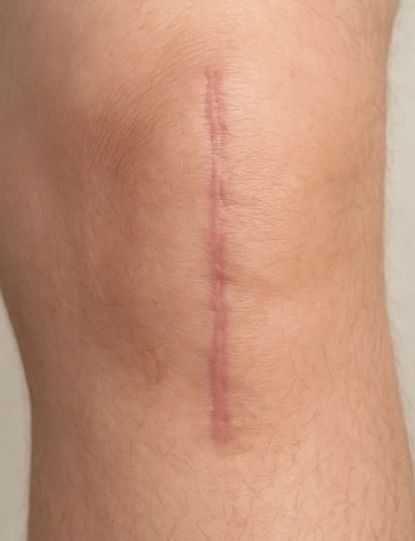
knee scar
Who should get a Scar Massage treatment?
Anyone with scarring
Anyone experiencing lymphatic swelling post surgery
Anyone looking to improve their mobility post surgery
Anyone looking to improve their recovery post surgery
Anyone experiencing menstrual issues following a caesarean birth
Why should you get Scar Massage therapy?
There are certain characteristics of scars which would benefit from Scar Massage therapy;
Tethering – scar mobilisation may loosen scars, which are firmly attached to underlying or surrounding tissues
Pain, hypersensitivity and itch– scar massage may improve such troublesome symptoms
Tightness – soft tissue manipulation may soften scars and increase pliability
Bulk– scar massage may help flatten certain bulky scars; nevertheless, keloid scars are unlikely to benefit
Scar Massage therapy can;
increase blood flow
hormonal release e.g. oxytocin
aid remodelling of the scar structure
How much does a Scar therapy treatment cost?
60 Mins
75 mins
Frequently Asked Questions
Q: How does Scar Therapy feel?
A: The feeling of scar therapy depends on the type of treatment you have and the age or sensitivity of your scar. Generally, scar therapy should not be painful. Most people describe the sensation as gentle massage, stretching, or light pressure on the skin.
During manual scar therapy, you might feel warmth, tingling, or mild tightness as the therapist works on the tissue. Some areas can feel slightly tender—especially if the scar is new or the tissue is still tight—but the therapist will always adjust the pressure to keep you comfortable.
Over time, as the tissue softens and mobility improves, many people notice that their scar area feels looser, smoother, and less sensitive.
Q: What happens during a Scar therapy session?
A: During scar therapy, the trained therapist works gently on and around your scar to help improve the look, feel, and movement of the affected area. The aim is to soften tight tissue, reduce sensitivity, and restore natural mobility in the skin and underlying layers.
A typical session may include:
-
Assessment: Your therapist will first examine the scar and discuss your medical history, healing process, and any symptoms such as tightness, pain, or numbness.
-
Hands-on treatment: Using gentle massage techniques, stretching, or myofascial release, the therapist works to loosen adhesions and improve blood flow to the area.
Q: Is Scar therapy suitable for everyone?
A: Scar therapy can be beneficial for many people, but it’s not suitable for everyone. The effectiveness and safety of treatment depend on several factors, including the type of scar, how old it is, your skin type, and any underlying medical conditions.
For example, people with very sensitive skin, certain skin disorders, or a history of keloid scarring may need a customized approach or may be advised to avoid some treatments. Pregnant individuals or those with certain health conditions should also consult a healthcare professional before starting scar therapy.
Book Now
To book a Scar therapy session call 07816 485 691 or book online on the homepage tab: